
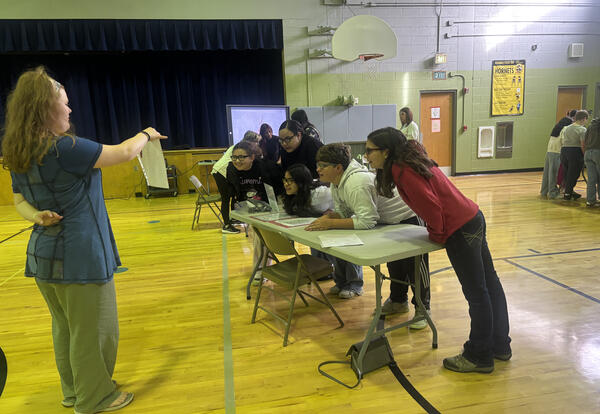
Rock Island Elementary students lean in and squint to read a page through unfamiliar glasses-part of the IDEA Project’s vision simulation on understanding different abilities.
What does it feel like to see the world through someone else’s eyes? Rock Island Elementary students found out during the IDEA Project, a disability awareness experience that encourages compassion through hands-on learning. The IDEA Project, a non-profit organization that partners with schools across the region, helps students recognize that a “disability is just a different ability.”
The multi-day experience began with a 40-minute interactive assembly introducing the idea of differences and inclusion through discussion, activities, and a short video. During the presentation, students were encouraged to participate, share ideas, and reflect on how people of all abilities can contribute in meaningful ways. The assembly also fulfills Washington State’s requirement for disability awareness education, ensuring that all students receive instruction about understanding and respecting differences.
Following the assembly, students from all grade levels rotated through five hands-on activity stations, each simulating a different type of disability: learning (such as dyslexia), intellectual, speech and hearing, vision, and sensory differences. These experiences gave students a glimpse into what it might feel like to navigate the world with different abilities, encouraging compassion and perspective-taking.
Before students began, in-school presenter Haylie Carter encouraged them to think about empathy: “Why might we not say ‘this is so easy’? Because for other people, for those who have a disability, it’s not easy for them. What might be easy for you might be hard for me.”
As students worked through each station, their reactions showed genuine reflection. One student laughed while trying to read words shown in mismatched colors, saying “This is so hard!” Another admitted, “It made my brain feel confused.”
School counselor Rosalind White said the activities make inclusion real for students. “In order to help build inclusion and belonging within a school community our students need to engage in meaningful activities that expose and create an understanding of what others with disabilities may feel,” she explained. She added that this kind of learning supports the heart of Rock Island’s culture: “By hopefully fostering empathy or a better understanding that we all are different and that our differences don't diminish a person's worth or capacity to be an essential part of the community.”
This was year two of Rock Island’s four-year IDEA Project curriculum. Each year builds on the last through assemblies, videos, and interactive learning tailored to grade level, whether kindergarten or upper elementary students. Carter shared that the message resonates long after the activities end: “They remember from last year…this experience sinks in.”
Efforts like these directly support Eastmont’s Strategic Plan Priority #3, which emphasizes creating schools where all students feel connected, engaged, and belong. The IDEA Project will visit Lee Elementary School this winter as the next stop in Eastmont’s ongoing commitment to inclusion and understanding.
Want to get more news like this one? Go directly to the Join Community Groups sign-up page. View all Eastmont News.