
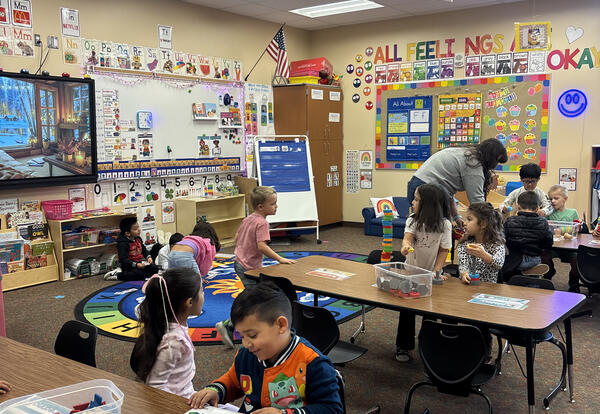
Students explore hands-on learning spaces in Dani Pieczynski’s TK classroom at Grant Elementary.
On a recent morning in Danielle Piezynski’s classroom at Grant Elementary, 18 students explored a room filled with play-based learning spaces: an art easel, sensory table, block center, puzzles, dress-up, and a cozy calm-down corner. Posters featuring ABCs, numbers, shapes, and colors line the walls near a banner that reads “Our Class is a Family.” Laughter, apologies, and problem-solving fill the room. During one math station, a student’s voice rises above the hum of activity: “I made a pattern!!” This is a morning in Eastmont’s Transitional Kindergarten.
For students who haven’t attended preschool or daycare, Transitional Kindergarten (TK) offers something kindergarten alone can’t: a gentle start. Pieczynski describes it as “protected time” for children to learn how to be both friends and students.
“We emphasize social and emotional growth with a heavy focus on play-based learning,” she explained. “Students gain confidence, cooperation skills, and the ability to self-regulate…the foundational skills for academic success.”
That growth is already visible. Many children can now write their names, identify numbers up to 10, and recognize shapes and colors, but Pieczynski says their growing independence stands out most: “They’ve gone from feeling like they need a grown-up to do everything to knowing they can do hard things.”
TK is also a proactive investment in school readiness and equity. Pieczynski compares it to teaching a child to swim: “You can throw them straight into the deep end, or you can wade in with them. TK is still school, but it’s intentionally designed for younger learners so they can grow, explore, and build the skills they need for kindergarten and beyond.”
Research consistently shows that early school success predicts later academic and social outcomes. TK helps ensure all students enter school ready, not just those who have had access to preschool or childcare.
Eastmont’s Transitional Kindergarten is free, full day, and offered at four elementary schools: Cascade, Grant, Lee, and Clovis Point. Students follow the elementary schedule but work with curriculum adapted for younger learners, supported by certified teachers who specialize in early childhood development.
The class also engages in real-world connections that help students expand their understanding of community. Recently, two members of the Wenatchee Fire Department visited as part of a unit on community helpers. It was an experience Pieczynski says is especially meaningful at this age. “At four and five, kids are beginning to shift from a self-focused perspective to understanding others. Real-world experiences make those concepts tangible.”
Whether students are working on early literacy, learning classroom routines, navigating friendships, or making real-world connections, each day in TK builds confidence, curiosity, and readiness. By the time they walk into kindergarten, they arrive not just prepared but proud.
As Pieczynski explained, “Our guest speakers were exciting, but they were just one part of a much bigger goal: helping TK students connect their early learning with the world around them.”
Want more stories like this? Sign up for Eastmont News emails to get weekly articles straight to your inbox. All Eastmont News linked HERE.