
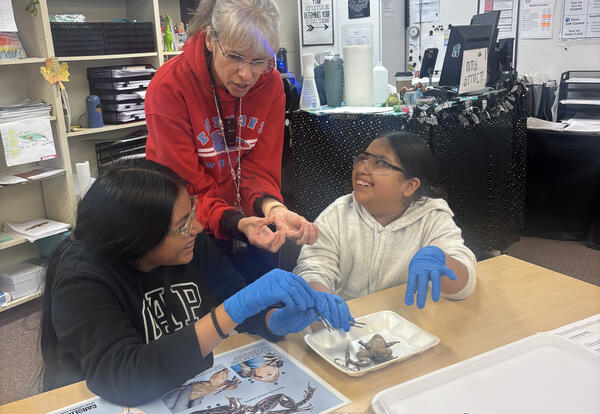
Kenroy Elementary’s Heather Stiver guides students as they explore frog anatomy during a hands-on science lab.
“Have fun with this!” Heather Stiver encourages, as students in her sixth-grade classroom at Kenroy Elementary leaned over trays, safety glasses on, carefully exploring the anatomy of frogs. Working in pairs, students used real scientific tools to examine organs firsthand as part of their Structures of Life science unit. Although sixth grade remains at the elementary level in Eastmont, science instruction is aligned to middle-school standards, giving students access to lab-based learning and scientific practices.
The room feels intentional. At one table, Stiver paused to ask a guiding question: “Do you have a gallbladder? Well, so does your frog.” At another, she reminded students to slow down and look closely. A few moments later, a student celebrated: “Mrs. Stiver! An intestine!”
For many students, this was likely their first (and possibly only) dissection experience. At first, some hesitated to make the first cut, glancing at their partner for reassurance. Laughter followed, then a deep breath, and soon both students leaned in together, encouraging one another as they worked. Instead of just memorizing diagrams from a book, students were able to see, touch, and identify real structures, helping abstract vocabulary make sense.
As students worked, Stiver moved from table to table, asking questions, clarifying observations, and reassuring students along the way. “Don’t be afraid to use your hands,” she told one group as they carefully compared organs and checked their reference sheets.
The dissection took place near the end of the unit and helped pull weeks of learning together. To show what they had learned, students completed a final project where they designed an imaginary single-celled organism and labeled its internal structures. They completed a similar assignment at the beginning of the unit, making it easy for students, and their teacher, to see how their understanding had grown over time. The final projects showed clear progress. Their designs, part science and part imagination, reflected both new knowledge and thoughtful creativity.
Experiences like this are part of sixth-grade science classrooms across Eastmont, where hands-on learning helps students build understanding, confidence, and a stronger connection to how science works in the real world.
Want more stories like this? Sign up for Eastmont News emails to get weekly articles straight to your inbox. All Eastmont News linked HERE.