
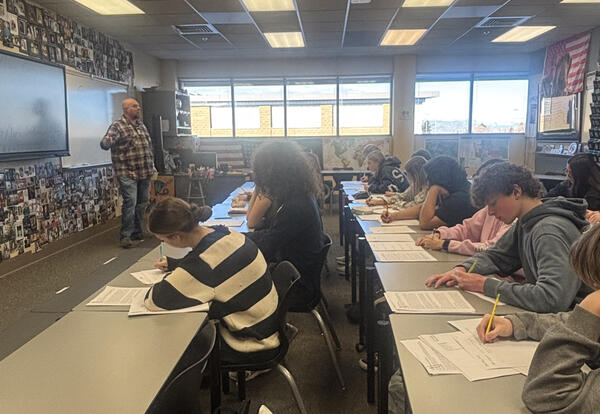
John Schmauder leads AP U.S. History students in analyzing historical claims and evidence, helping students build critical thinking skills in a college-level learning environment.
At Eastmont High School, AP U.S. History doesn’t feel like a typical history class. In a recent lesson, students reviewed detailed feedback on their essays, analyzing claims and historical reasoning with the kind of focus you’d expect in a college seminar.
“We’re shooting to be above the national average,” teacher John Schmauder told students as they reflected on their performance. Then, with a smile, he added, “I’m not preparing you for the AP test; I’m preparing you for what?” The room answered in unison: “college!”
For Schmauder, an Eastmont graduate himself, the goal goes even further. He sees AP classes as preparation not just for graduation or freshman-year coursework, but for the long arc of students’ academic goals, including advanced degree programs and careers. “These classes provide individualized education to what our students’ future plans are,” he said.
The course content spans roughly 600 years of history, from pre-Columbian societies to the present day. Students recently wrapped up a unit leading into World War I and are now moving into the Roaring Twenties and the Great Depression, building a long-term historical framework that requires them to connect patterns, policies, presidencies, and social movements across time. With the AP exam scheduled for early May, the pace is demanding by design.
The course challenges students to organize vast amounts of information and develop the analytical habits needed to make sense of complex historical narratives. Written on the board is a clear semester goal: Improve critical thinking skills. That emphasis shows up in how students work together. “These students develop relationships that are both supportive and competitive,” Schmauder said. “They have to study together to be successful…but at the end of the day, they’re also each other’s competition.” The result is a classroom culture that blends collaboration, accountability, and academic rigor. Earning a qualifying score on an AP exam places students among top-performing peers nationwide and can lead to college credit or advanced placement at many universities.
Schmauder’s classroom tells its own story. The walls are covered with hundreds of photos of past Eastmont graduates, visual reminders of the many students who once sat in those same desks. Student-made posters about the Constitution, historical maps, and flags from different eras and regions line the room, reinforcing the idea that learning here is active, visual, and anchored in context. The workload is real, the expectations are high, and the learning is deep.
As Eastmont continues to prioritize academic excellence, AP U.S. History stands as one example of how rigorous coursework prepares students for the expectations of post-secondary learning.
Want more stories like this? Sign up for Eastmont News emails to get weekly articles straight to your inbox. All Eastmont News linked HERE.