
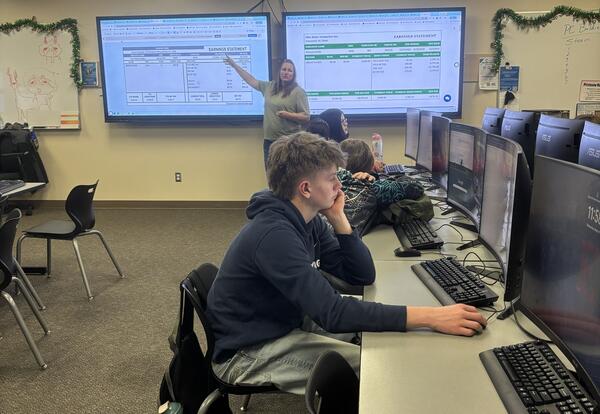
Eastmont High School students analyze pay stubs and tax forms as part of a Financial Literacy lesson focused on real-world money management skills.
What began as a common question of “Do students learn how to manage money or do their taxes in school?” led to a shift from a long-standing elective to a graduation requirement at Eastmont High School.
In Financial Literacy, a Career and Technical Education (CTE) course taught by Telenna Peterson and others in the CTE Business Education Department, juniors build the skills they need to navigate real-world financial decisions with confidence.
Washington State has been building toward stronger financial education for years, making it a graduation requirement in 2022 for students beginning with the Class of 2027. New legislation in 2026 continues that momentum by expanding access and support statewide. Eastmont School District adopted this requirement even earlier (2019), placing the district ahead of the curve. This progress is largely due to the work of CTE Business Teacher Mr. Mark Bloom, CTE Director Jim Schmutzler, and supportive community members. In 2020, Eastmont was recognized with the Gold Standard Challenge and received a $10,000 award from Next Gen Personal Finance, a national leader in financial education.
Inside the classroom, learning is practical and immediate.
In one lesson, students began with an entry task on withholdings and deductions, working through W-4 forms and examining the fine print behind their paychecks. As Peterson guided the discussion, she reminded students, “Taxes aren’t just for helping you personally—they also support public goods and services,” prompting deeper thinking about where their money goes.
Students explored the purpose of taxes, asked questions about paychecks, and connected government spending to their everyday lives. They practiced reading pay stubs (an essential skill for many already working) by analyzing federal and state taxes, as well as the difference between gross and net pay. To close the lesson, students responded to an exit question: What important information is on your pay stub?
The course extends far beyond a single lesson. Students study budgeting, banking, credit and debit, taxes, and post–high school planning. They explore pathways such as college, trades, apprenticeships, and the military, while also preparing resumes and building career-ready skills.
Students also apply their learning through interactive simulations, managing paychecks, paying bills, and experiencing automatic deductions in real time. These simulations provide a safe space to practice financial decision-making before it matters most.
For Peterson, who has over 20 years of teaching experience and has been part of the EHS Business Department since 2010, the goal is clear. “Financial literacy builds skills for life as an adult,” she said. “This class is a route to their financial futures. We’re not just pushing college…we’re giving students options and the tools to reach their individual goals.”
As part of Eastmont’s CTE Business program, Financial Literacy connects classroom learning to real-world application, helping students build independence, confidence, and a stronger sense of their future.
At Eastmont, that once-common question about whether students learn to manage money or understand taxes in school is no longer a question. It’s an expectation. Our students are learning skills to become competent, confident, and thoughtful decision-makers in their lives beyond high school.
Want more stories like this? Sign up for Eastmont News emails to get weekly articles straight to your inbox. All Eastmont News linked HERE.