
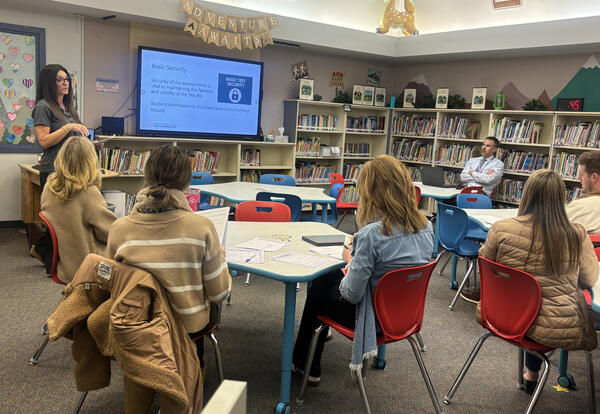
District Assessment Coordinator Natalie Dorey leads annual training for teachers ahead of spring state assessments, helping ensure testing is secure, consistent, and fair for all students.
Each spring, students across Washington participate in state and federal assessments. You may hear names like Smarter Balanced, WA-AIM, or WIDA ACCESS and wonder what they mean…or why they matter.
At Eastmont, these tests are viewed as a “dipstick,” not a diagnosis. Like checking the oil in a car, they provide a quick snapshot of what’s going well and where support may be needed. They are one piece of a larger picture that includes classroom learning, teacher feedback, and daily student experiences.
So what are these tests, and what do they actually tell us about student learning?
Smarter Balanced Assessment (ELA & Math)
Students in grades 3–8 and 10 take the SBA in English Language Arts and Math. It measures reading, writing, and critical thinking, not just memorization of facts. The test is adaptive, meaning questions adjust based on student responses to better identify their level of understanding. It also includes real-world tasks where students apply their learning. Results help teachers adjust instruction and give families a general sense of progress. As District Assessment Coordinator Natalie Dorey shares, “The Smarter Balanced Assessment provides meaningful information on how our systems (state, district, and school) are working and where we can improve to better support students.”
WA-AIM (Washington Access to Instruction & Measurement)
WA-AIM is the alternate assessment for students with the most significant cognitive disabilities, as determined by an IEP team. It aligns to grade-level standards while meeting each student’s learning and communication needs.
WIDA ACCESS (English Language Development)
WIDA ACCESS is taken by Multilingual Learners and measures growth in listening, speaking, reading, and writing in English. It helps schools guide instruction and determine supports. The focus is on growth, not perfection.
Accommodations: Supporting Every Learner
All students are supported in accessing assessments. Supports may include extended time, small group settings, translated directions, or assistive technology. These are based on IEPs, 504 Plans, or language needs and do not change what is measured, only how students access the test. The goal is fairness, not sameness.
Why Participation Matters
These assessments provide important information about how well schools support students. When students take part, we gain more accurate data to guide decisions, improve instruction, and plan resources. It also helps districts meet state requirements.
How Much Time Does Testing Take?
State assessments make up less than 1% of the school year and are given in shorter sessions to minimize disruption to learning time.
A Final Thought
At Eastmont, no single test defines a student. These assessments are just one way teachers reflect, adjust, and improve, supporting every student as they grow into competent, confident, and compassionate learners.
Want more stories like this? Sign up for Eastmont News emails to get weekly articles straight to your inbox. All Eastmont News linked HERE.