
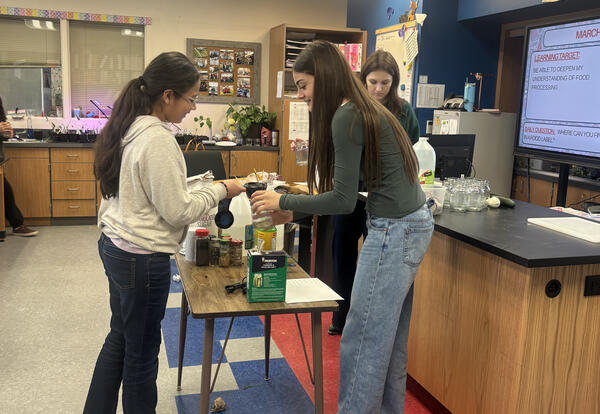
Sterling Junior High students in 7th Grade Ag Science make pickles as part of a food processing unit, applying hands-on learning in the classroom.
At Sterling Junior High, science class sometimes comes in a mason jar.
In 7th Grade Ag Science, students recently made pickles as part of a food processing unit, using recipes they designed themselves.
In Kadince Compton’s classroom, learning often looks different from a traditional science setting. Plants grow under heat lamps along the windowsills, and banners from the NCW Fair hang overhead. On this day, students measured ingredients, packed jars with cucumbers, garlic, and spices, and created nutrition labels to go along with their finished products.
The class blends core science concepts with real-world applications. Students study topics including the scientific method, states of matter, atoms and elements, plants, animals, water systems, and agriculture in the future. “Students have the opportunity to try things hands-on, like planting, pickling, and recycling, that they might not get in other classes,” Compton said.
A key part of the course is the SAE (Supervised Agricultural Experience) project, which extends learning beyond the classroom. A SAE is any experience related to agriculture that students complete outside of class, with many logging at least 10 hours over the course of the year. Some students raise animals, while others work in family restaurants or take on gardening projects.
The program also connects students to leadership and competition opportunities through FFA, including team events and state-level participation. The group is also preparing for its annual plant sale in early May.
Through both classroom experiences and extended projects, students gain skills that reach beyond junior high.
For some students, the impact starts with simple connections. “Some students didn’t know pickles were made from cucumbers so this was an opportunity to link where our food actually comes from,” Compton said.
Whether they are planting, experimenting, or preserving food, students are building a deeper understanding of science while developing practical skills they can carry into future careers, and maybe even into their next mason jar.
Want more stories like this? Sign up for Eastmont News emails to get weekly articles straight to your inbox. All Eastmont News linked HERE.